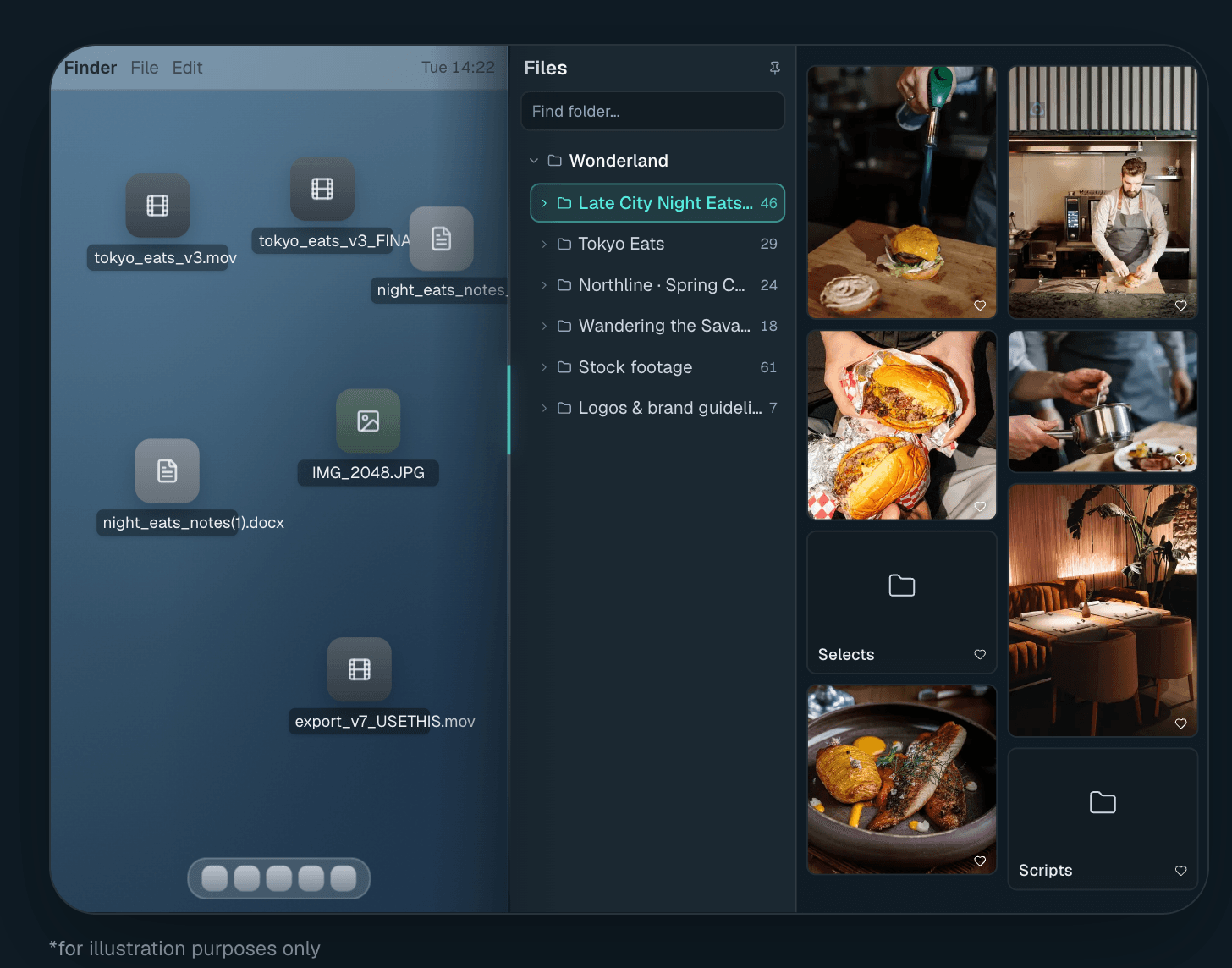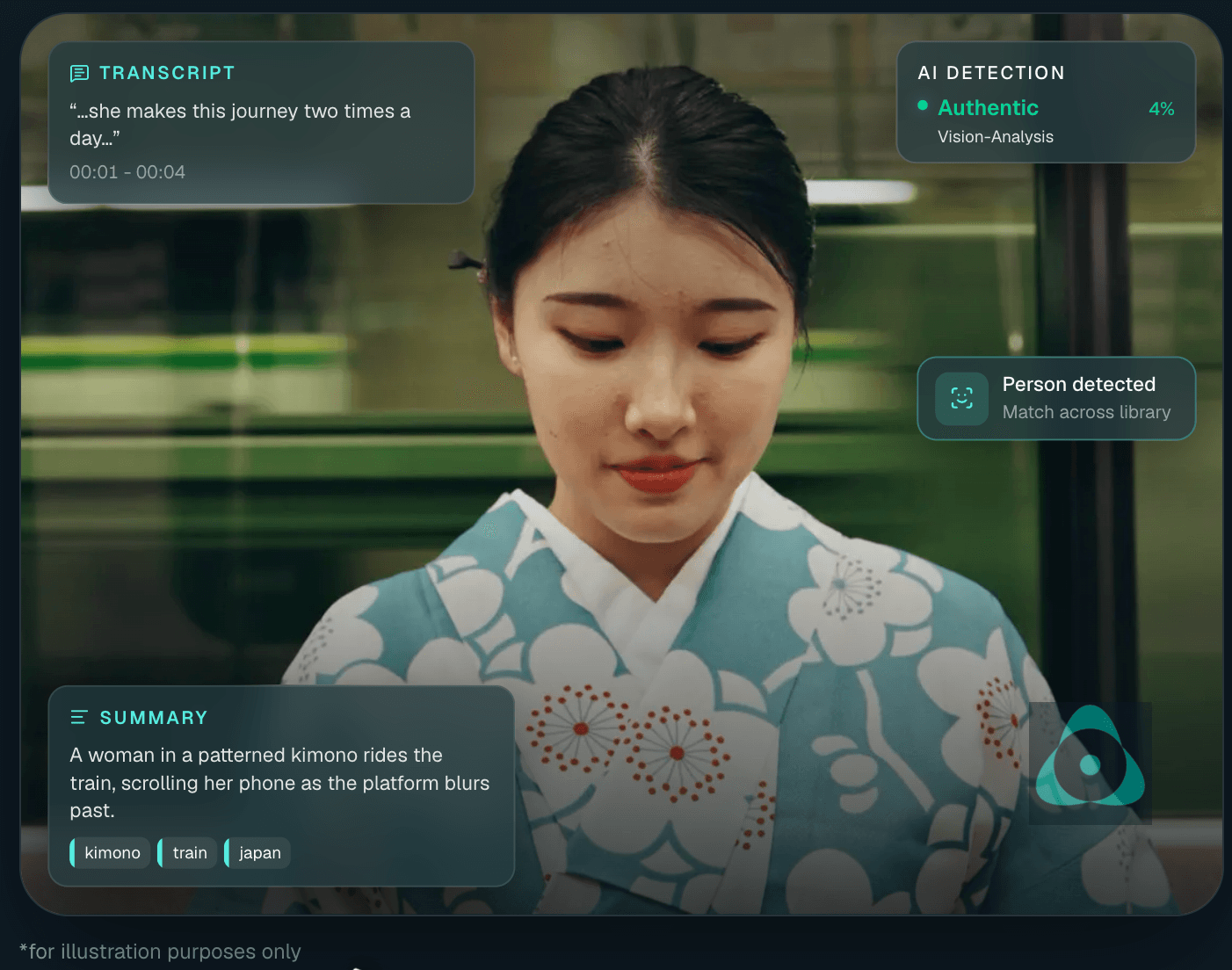
With the vertiginous speed and sophistication of modern content delivery, especially in fast moving sectors like news, finance, and social media, the shift enabled by Agentic AI will be dominated by context intelligence. Semantic search now provides media teams with the most valuable of insights to create their content at speed.
The value of archives and assets that can be fully understood in context is the way that media companies can fully realise their return on investment. In AIR Fusion, our natural language agent Fuse interacts with the creative to provide valuable insights and exact moments that can be pooled from the archive as a whole. With AIR Fusion we can technically see and understand what is inside each clip or file: the colourway, the C2PA provenance, AI detection, format, timecode, the moment. This is an important shift from just content intelligence to context intelligence: what can we use this clip for as it relates to the project, and how it fits with everything else.
Context Intelligence is becoming the thing that decides whether your media is actually usable by the AI agents your media team is starting to rely on.
What content intelligence solved
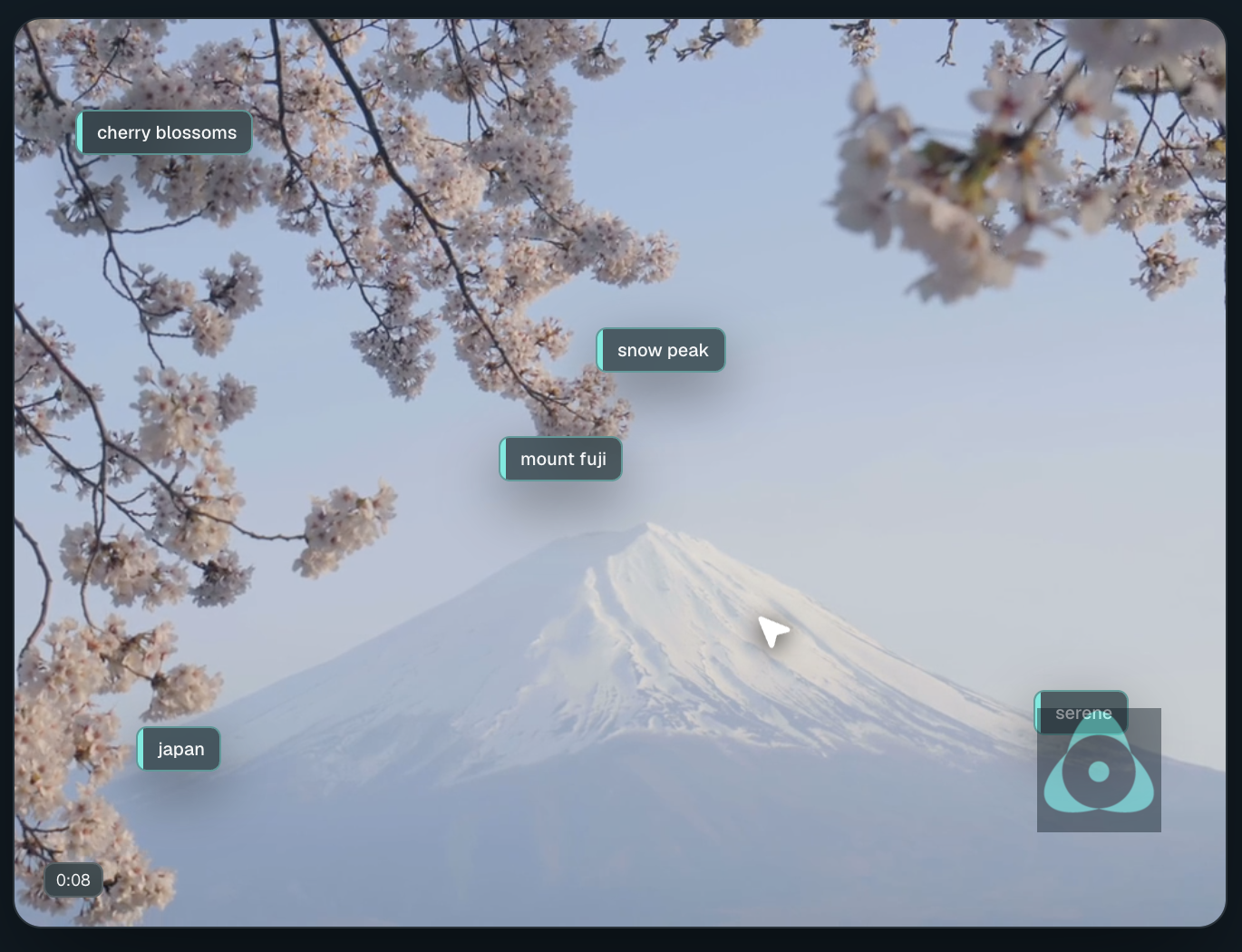
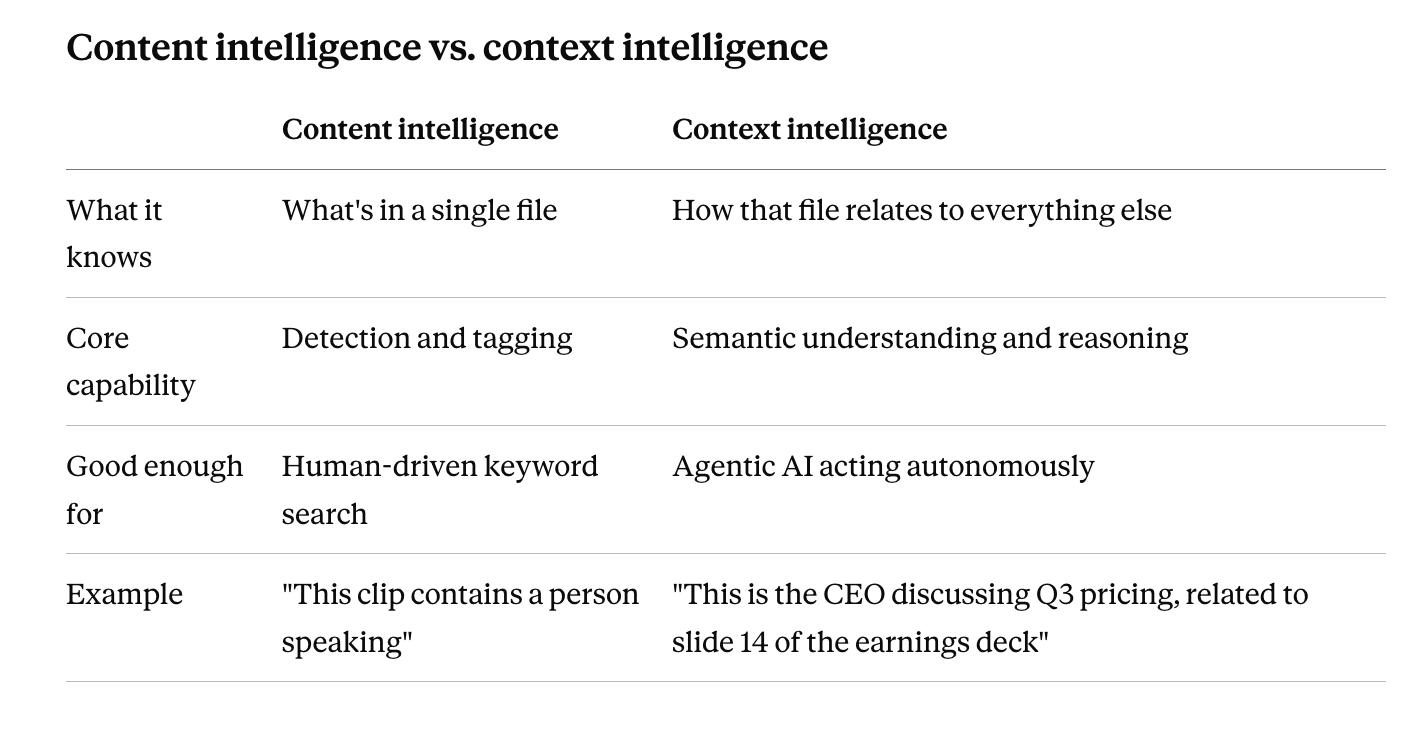
Content intelligence is the capability most AI-powered media tools have today: analyse a file and describe what is in it. A person, an object, a location, a spoken word, a sentiment. It is genuinely useful, and it is the reason search can work by what is in a video instead of by whatever it happened to get named.
But content intelligence describes a file in isolation. It can tell you a clip contains "a person speaking in an office." It cannot tell you that person is your CEO, that the clip is from the Q3 earnings call, that it directly follows a slide about pricing, or that it contradicts something said in a different meeting six months earlier. That is not a content problem. It is a context problem.
What context intelligence adds
Context intelligence is the layer above content intelligence: understanding how a piece of media relates to everything around it, other assets, other moments in the same file, external data, and the intent behind why someone is looking for it in the first place. It requires semantic understanding, not just detection: knowing what something means, not just that it is there.
A few concrete examples of what that looks like in practice:
- Recognising that "the CEO" and a specific named person are the same entity across hundreds of files, not just tagging a face in each one separately.
- Connecting a transcript's content to a plausible intent ("discussing pricing") rather than just transcribing the words.
- Understanding a piece of sports footage in relation to official game data, which player, which play, which quarter, instead of just detecting "person, field, ball."
- Knowing that two assets are versions of the same underlying content, or that one is a repurposed clip of another.
This is the difference between a system that can describe your media and one that can actually reason about it.
Why this matters specifically for agentic AI
Content intelligence was built for a world where a human was still doing the searching, AI just made the search terms richer. Agentic AI, like our agent Fuse, changes that assumption. An AI agent is not just running a search on your behalf; it is making decisions, chaining steps together, and acting on what it finds, often with no human checking each step along the way.
That raises the bar considerably. An agent asked to "find the clips of all the first goals in the season" has to understand what counts as a "first goal", which assets are relevant, how they relate to each other, and in what order they should go; none of which is answerable from content tags alone. Agentic-AI-ready content means media that carries enough context, structure, and machine-readable metadata that an agent can act on it correctly without a human filling in the gaps by hand.
This is also where Model Context Protocol (MCP) matters. MCP is the emerging standard that lets AI agents like Claude connect directly to AIR Fusion and interact with the content the way a person would, but through a structured, permissioned interface instead of screen-scraping or guessing. An agent connected via MCP is only as useful as the context it is handed. Rich tags help. Real semantic understanding of how assets relate to each other is what actually lets an agent complete a multi-step task correctly.
How AIR Fusion builds context intelligence in
AIR Fusion's media intelligence layer was built with this shift in mind, as an AI-Native platform, not bolted on after the fact:
- Entity resolution, not just detection. Faces, names, and mentions are connected across your entire library.
- Full transcripts with speaker separation, translated into 100+ languages, giving agents the actual language and meaning behind a moment, not just a visual tag but a way to confirm accuracy. Humans in the loop can edit these where required.
- Content provenance via C2PA, so an agent (or a person) can trust where an asset actually came from before acting on it, especially when the request involves anything public facing.
- Fuse, AIR Fusion's own AI agent, which is built to reason across this context layer directly. Asked to find "where they discuss building winning teams," Fuse is not matching keywords; it is understanding intent and pulling from everything it knows about the footage.
- A native MCP server, so external agents like Claude can query your library with the same context-aware understanding Fuse has internally, using your existing AIR Fusion permissions rather than a separate access layer.
Content intelligence vs. context intelligence
The bottom line
Content intelligence got media libraries searchable. Context intelligence is what makes them usable by AI agents that act, not just search. As more teams start handing real tasks to agentic AI, through tools like Claude, Copilot and the MCP servers that connect them to real data, the media libraries that hold up will not just be the best-tagged ones. They will be the ones an agent can actually understand and reason about correctly, the first time, without a person double-checking every step.
Frequently asked questions
What is context intelligence? Context intelligence is the ability to understand how a piece of media relates to everything around it, other assets, prior context, and intent, rather than just detecting what is inside a single file, which is what content intelligence does.
How is context intelligence different from content intelligence? Content intelligence detects and tags what is in a file (people, objects, locations). Context intelligence goes further, understanding relationships between assets, resolving entities across a library, and reasoning about intent: the semantic understanding an AI agent needs to act correctly, not just search.
What does "agentic-AI-ready" content mean? It means media that carries enough structured, machine-readable context and metadata that an AI agent can search, retrieve, and act on it autonomously, without a person necessarily filling in missing context manually.
What is MCP and how does it relate to context intelligence? MCP (Model Context Protocol) is a standard that lets AI agents like Claude connect directly to external tools and data sources, including a media library, through a structured interface. Context intelligence is what makes that connection useful: an agent connected via MCP still needs real semantic understanding of the content to complete tasks correctly.
Does AIR Fusion support agentic AI tools like Claude? Yes. AIR Fusion has a native MCP server that connects your library to Claude, using your existing AIR Fusion permissions, so an agent can search and retrieve content with the same context-aware understanding built into AIR Fusion's own AI agent, Fuse. Copilot integration is coming soon.
AIR Fusion is the AI-native media workspace built for context, not just content: search by meaning, understand your library, and make it agent ready. Book a demo or see pricing.